How to Style a Sideboard: 8 Simple Rules (and Ideas for Every Room)
A well-styled sideboard can pull a whole room together. A badly styled one becomes a dumping ground for post, keys and chargers.
The difference usually isn’t money. It’s a handful of simple principles that stylists use without thinking: height, grouping, balance and restraint. Once you know them, you can style any sideboard in about ten minutes using things you already own.
Below, we’ll walk through the eight rules our stylists rely on, then show how to apply them in the dining room, living room and hallway.
1. Start With an Anchor on the Wall
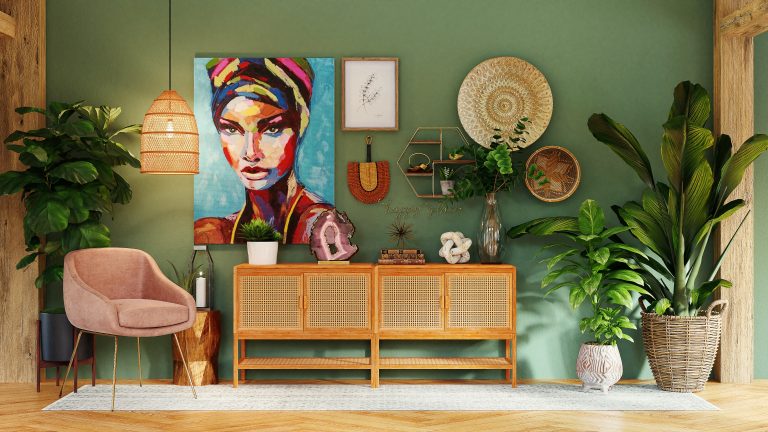
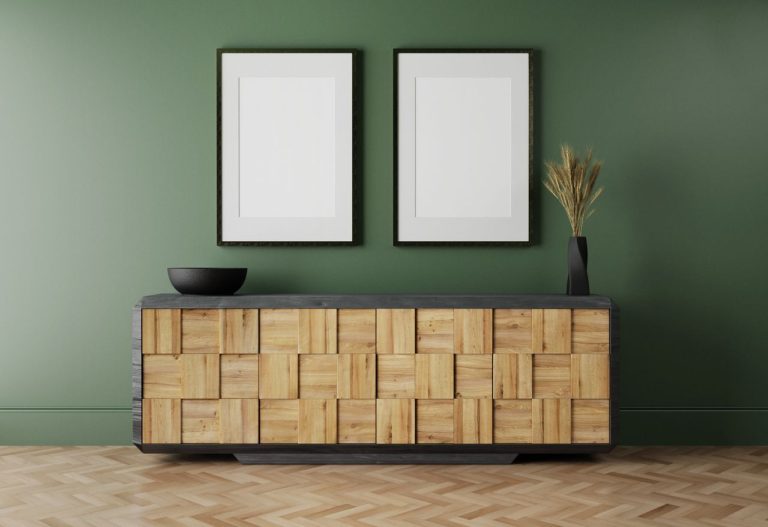
Every good sideboard arrangement starts above the sideboard. A large piece of art, a mirror or a group of frames gives the eye a focal point and stops the display looking like a row of objects floating on a shelf.
- Size it right: aim for art or a mirror roughly two-thirds the width of the sideboard. Anything much smaller looks lost.
- Hang it low: leave around 20-30cm between the top of the sideboard and the bottom of the frame, so the two read as one arrangement.
- Lean instead of hang: propping a large frame against the wall feels more relaxed, and it’s easier to change with the seasons.
2. Add Height at One or Both Ends
Once the wall is sorted, bring in your tallest pieces. A table lamp is the classic choice, because it adds height and gives you soft, low-level light for the evening.
You can go one of two ways:
- Symmetrical: a matching pair of lamps at each end. This feels formal and calm, and suits traditional dining rooms.
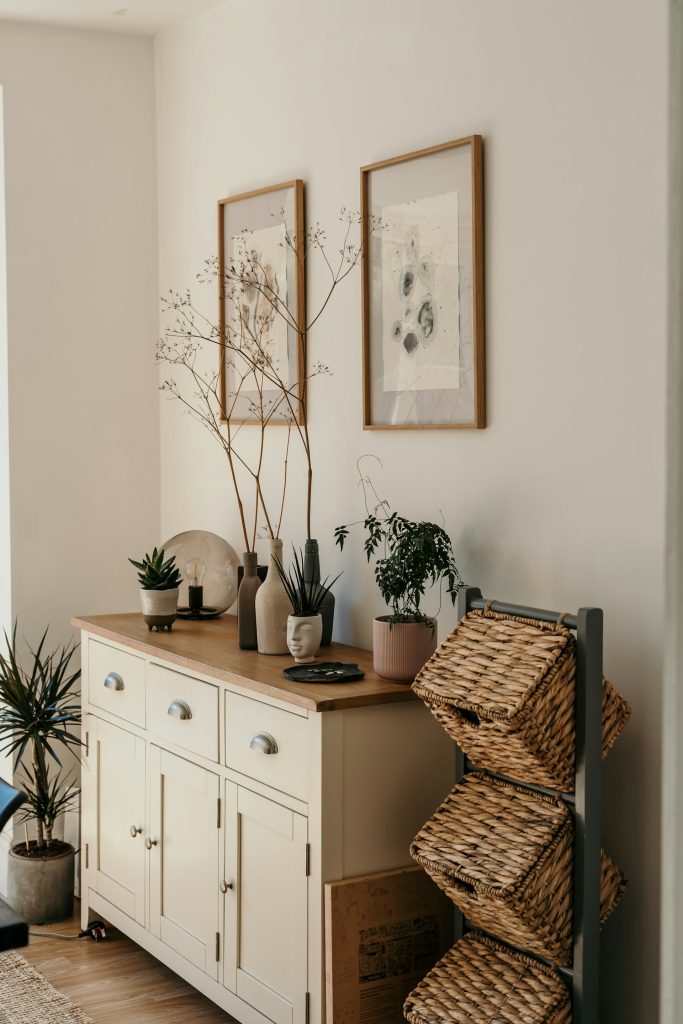
- Asymmetrical: one tall lamp or a large vase of branches at one end, balanced by a lower, wider grouping at the other. This feels more relaxed and modern.
Either works. The mistake is having everything at the same height, which looks flat.
3. Group Objects in Odd Numbers
Stylists group things in threes and fives because odd numbers feel more natural and less staged than pairs.
A simple formula for each group is something tall, something medium and something low. For example, a vase, a small stack of books and a candle. Vary the shapes too: mix round with square, and solid with open.
4. Use the Triangle Rule
Step back and imagine lines connecting the tops of your objects. The most pleasing arrangements form a triangle, with the highest point at one end or in the middle and the heights stepping down from there.
If your arrangement looks off and you can’t tell why, it’s usually because there’s no clear high point or the heights are all similar.
5. Layer From Back to Front
Place larger, flatter items (frames, trays, books) towards the back, and smaller objects in front. Overlapping pieces slightly creates depth and makes the display feel collected rather than lined up.
Stacked books are a stylist’s secret weapon. Lay two or three horizontally to create a mini plinth for a small object, which instantly adds a new height.
6. Bring in Something Living
A plant, a bunch of fresh flowers or even a few cut branches adds colour, texture and life to a sideboard. Trailing plants such as pothos soften hard edges and look great tumbling over one end.
If your sideboard gets little light, faux stems or dried flowers like eucalyptus and pampas grass do the same job.
7. Mix Textures and Finishes
Sideboards are often flat, smooth surfaces, so add contrast with what you put on them: ceramic next to glass, brass next to wood, linen next to stone.
Take your lead from the sideboard itself. A warm wood sideboard, such as an oak or mango wood design, comes alive with cool marble or white ceramics. A crisp white sideboard suits warmer accents like rattan, terracotta and aged brass.
If your sideboard already has a glamorous finish, such as a gold or mirrored sideboard, go easy on the shine on top. Matt ceramics, linen and greenery stop it tipping into too much.
8. Leave Some Empty Space
The most common sideboard mistake is overfilling it. Clear space gives each object room to be seen, and it stops the surface looking cluttered.
As a rough guide, keep around a third of the top clear. If in doubt, take one thing away. And give keys, post and chargers their own home inside the sideboard, in a drawer or a small lidded box.
How to Style a Sideboard in Each Room
Dining room
In a dining room, the sideboard should be practical as well as pretty, because you’ll want space to serve food or set out drinks.
- Keep the centre clear, or use a large tray that can be moved quickly when you need the surface.
- A pair of lamps or candlesticks suits a traditional dining room, especially with a symmetrical mirror above.
- Display things you use: a decanter and glasses, a fruit bowl or a stack of serving plates.
Living room (with a TV)
If your TV sits on the sideboard, it becomes the anchor, so keep everything else lower and simpler.
- Place a plant or a lamp at one end and a small grouping of books and objects at the other.
- Avoid anything that blocks the screen or crowds the edges.
- Choose a sideboard wide enough to leave clear space either side of the TV. Our sideboard dimensions guide and TV unit size guide have the measurements.
Living room (without a TV)
Without a TV, the sideboard can be a proper display piece.
- Go big with art above, and build out using the triangle rule.
- A slim, warm-toned piece, such as a walnut or mid-century sideboard from brands like Loaf or Heal’s, looks great with sculptural ceramics and a single dramatic stem.
Styling Ideas by Sideboard Style
The same eight rules apply to every sideboard, but the objects you choose should suit its style.
| Sideboard style | What to put on it |
|---|---|
| Mid-century | A mushroom or globe lamp, sculptural ceramics, a record player or a stack of design books |
| Scandi | A paper or linen lamp, a single branch in a clear vase, pale ceramics; keep it sparse |
| Industrial | Black metal frames, an Edison-bulb lamp, concrete or stoneware pots |
| Art deco | A pair of fluted or globe lamps, a round mirror, brass trays and coloured glass |
| Vintage or mahogany | Old books, a traditional lamp with a pleated shade, pewter or brass candlesticks |
| Fluted | Smooth, simple shapes that let the texture show: a plain vase, a single bowl, a round mirror |
When in doubt, repeat one material from the sideboard in an object on top, such as brass handles echoed in a brass bowl. It makes the whole arrangement look planned.
Hallway
Hallway sideboards need to work hard in a small space, so keep the styling simple.
- A mirror above is a must. It bounces light around a dark hallway and lets you check your reflection on the way out.
- Add a lamp for a warm welcome when you come home.
- Use a shallow bowl or tray for keys, so everything else stays tidy.
- If your hallway is narrow, choose a slim hallway sideboard or a small sideboard to keep the walkway clear.
Common Sideboard Styling Mistakes
- Art that’s too small for the sideboard, which makes both look awkward.
- Everything the same height, so the display looks flat.
- Too many small objects, which read as clutter rather than a display.
- Hanging art too high, leaving a big gap that disconnects it from the sideboard.
- Ignoring the sideboard’s colour. A busy display on a patterned or brightly coloured sideboard can feel chaotic. Let one of them be the star.
- Clashing woods. A wooden bowl or frame that’s almost the same shade as the sideboard looks like a mistake. Our guide to mixing wood tones explains how to get it right.
Seasonal Sideboard Refreshes
One of the easiest ways to keep a room feeling fresh is to restyle the sideboard a few times a year.
- Spring: fresh tulips, light linen and pale ceramics.
- Summer: greenery, natural textures like rattan, and lighter art.
- Autumn: dried grasses, warm terracotta and amber glass.
- Winter and Christmas: candles, a garland of foliage along the top, and a few metallic accents.
Keep the anchor pieces (art, lamps and a large vase) the same, and swap only the smaller objects. It’s quicker and cheaper.
Sideboard Styling FAQs
What should I put on top of my sideboard?
A good starting point is art or a mirror above, a lamp or tall vase at one end, and a group of three smaller objects such as books, a candle and a plant. Leave some space clear.
How do I style a sideboard with a TV?
Let the TV be the focal point and keep surrounding items low and minimal: a plant at one end and a small stack of books at the other. Avoid anything that blocks the screen.
Should a mirror be wider than the sideboard?
No. A mirror or piece of art about two-thirds the width of the sideboard usually looks best. Never go wider than the sideboard itself.
How high should art be above a sideboard?
Leave roughly 20-30cm between the top of the sideboard and the bottom of the frame.
Should sideboard decor be symmetrical?
It doesn’t have to be. Symmetry feels formal and calm, while asymmetry feels relaxed and modern. Just make sure both ends feel balanced in visual weight.
Get a Sideboard That’s Easy to Style
The easiest sideboard to style is one that’s the right size and finish for your room in the first place. You can browse sideboards from over 100 UK retailers on Flitch and filter by size, colour, material and style, from warm wood to soft neutral finishes.
Or let us do the hard work. Tell a Flitch stylist about your room, your style and your budget, and we’ll send you a handpicked shortlist of sideboards, with ideas for styling them too.
Ready to shop?
Compare prices and styles from over 100 UK retailers in one place.