How to Mix Wood Tones in a Room (Without It Looking Mismatched)
Very few homes are furnished in one go from one shop. A dining table from one retailer, a sideboard from another, a coffee table inherited from family, floorboards that came with the house: before long you’ve got four or five different woods in one room.
That’s a good thing. Rooms where every wood matches can feel flat and showroom-like. Mixed woods add warmth and character, and make a home look like it’s been collected over time.
But there’s a difference between mixed and mismatched. In this guide, we’ll explain the simple rules that make different wood tones work together.
Why Matching Wood Is No Longer the Goal
Buying a full matching suite of furniture used to be the norm. Today, most interior designers deliberately mix woods, because:
- It adds depth and contrast, so each piece stands out.
- It makes a room feel personal rather than bought from a single catalogue.
- It’s practical: you can buy each piece where it’s best value, rather than being locked into one range.
The catch is that wood finishes vary a lot between brands. Two pieces both described as “natural oak” can look noticeably different side by side. So rather than trying to match exactly, it’s better to learn how to mix well.
Step 1: Choose Your Dominant Wood
Start with the wood that covers the most area in the room. This is usually:
- Your floor, if it’s wooden, or
- Your largest piece of furniture, such as a dining table, sideboard or wardrobe, if the floor isn’t wood.
This is your dominant tone. Everything else should be chosen to sit comfortably alongside it, rather than compete with it.
Step 2: Match the Undertones, Not the Colour
This is the single most important rule. Every wood has an undertone, and woods with the same undertone almost always look good together, even if they’re very different shades.
| Undertone | Looks | Common examples |
|---|---|---|
| Warm | Yellow, orange or red hints | Golden oak, pine, cherry, teak, mahogany |
| Neutral | Balanced, neither warm nor cool | Natural oak, walnut |
| Cool | Grey, ashy or slightly green hints | Ash, grey-washed and weathered oak, smoked finishes |
How to check: look at the wood in natural daylight next to a sheet of white paper. If it looks yellow or orange, it’s warm. If it looks grey or ashy, it’s cool.
A warm honey oak table with a cool grey-washed sideboard can clash, even though both are “oak”. A pale warm pine and a rich warm teak, on the other hand, can look great together despite being very different shades.
Step 3: Contrast Clearly or Match Exactly
The hardest combination to get right is two woods that are almost the same. They look like a failed attempt to match.
So either:
- Match exactly, by buying pieces from the same range, or
- Contrast clearly, by putting light woods with dark woods, so the difference is obviously deliberate.
A good rule of thumb is to aim for at least two shades of difference. Light oak and walnut look intentional. Light oak and slightly-less-light oak don’t.
Step 4: Stick to Two or Three Tones
You can absolutely have more than one wood in a room, but too many tones start to feel chaotic. Most designers suggest:
- One dominant tone (around 60-70% of the wood in the room)
- One secondary tone (around 20-30%)
- One accent tone (around 10%), often in small pieces like frames, bowls or a side table
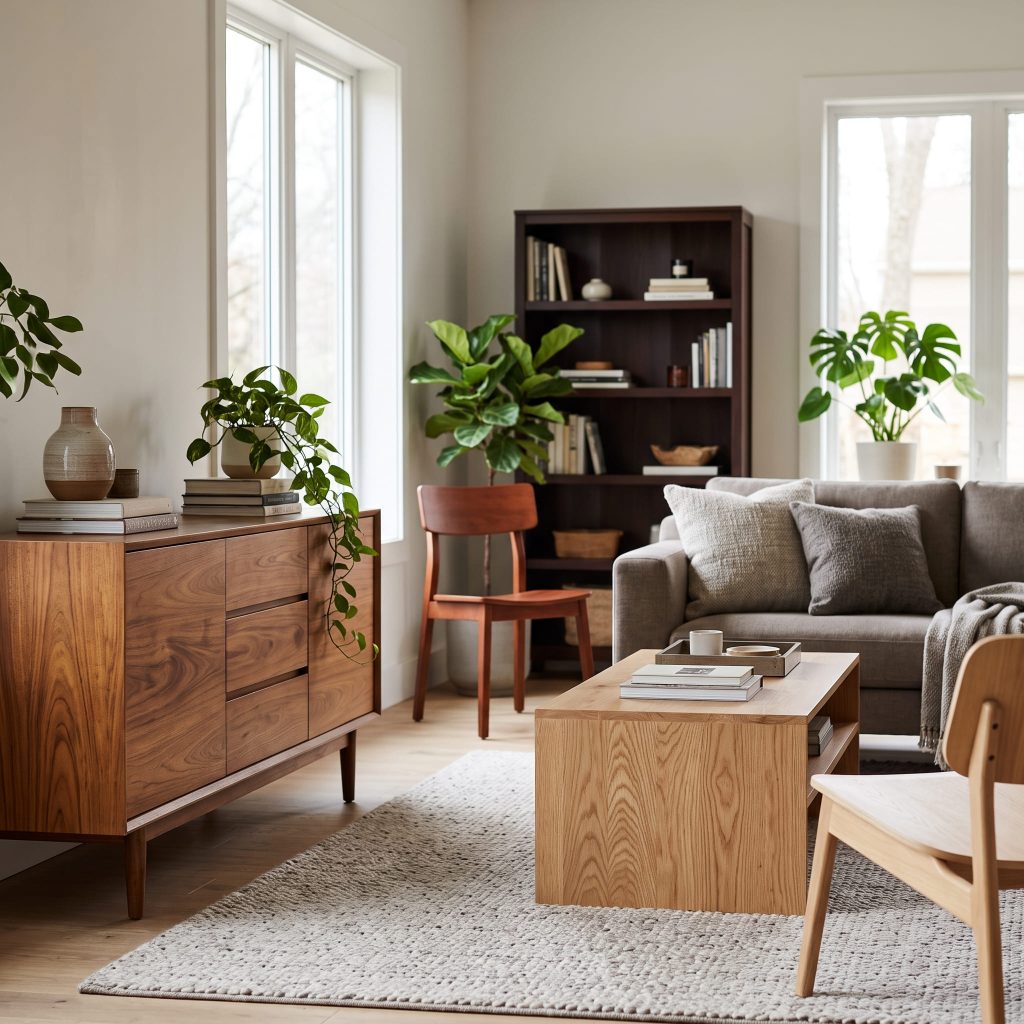
A popular combination is light oak as the dominant tone, walnut as the secondary, and black as the accent. In a living room, that might look like an oak coffee table, a walnut sideboard and black picture frames.
Step 5: Repeat Each Tone at Least Twice
A single dark wood piece in an otherwise light room can look like it wandered in by mistake. Repeating it somewhere else, even in something small, makes it look planned.
For example, if you add a walnut sideboard to a room full of light oak, echo the walnut in a picture frame, a lamp base or a stool on the other side of the room. Spread each tone around rather than clustering it in one corner.
Step 6: Use Something to Separate Them
When two woods sit right next to each other, something in between helps them coexist. Good separators include:
- A rug between a wooden floor and a wooden coffee table or dining table
- Upholstery, such as fabric dining chairs around a wooden table
- Metal, especially black, brass or chrome legs and frames
- Painted pieces, such as a white or coloured sideboard among natural woods
- Stone and glass, such as a marble-topped side table
These give the eye a break and stop the room feeling like a wall of brown.
Mixing Wood Tones Room by Room
Living room
Your floor or sofa is usually the starting point. If you have wooden floors, choose a coffee table and sideboard that contrast with the floor rather than almost matching it, and lay a rug underneath to separate them.
- Pale floors suit darker pieces such as a walnut coffee table or a dark wood sideboard.
- Mid-tone floors pair well with light, matt woods, such as Scandi coffee tables or an oak sideboard.
- Dark floors can take characterful, textured pieces. Rustic and reclaimed wood coffee tables add warmth without disappearing.
A sideboard in a contrasting tone makes a strong focal point, and a rich mahogany sideboard can anchor a room full of lighter woods. Our guide to styling a sideboard shows how to repeat its tone in the accessories around it.
Dining room
The dining room is the easiest place to experiment. You can contrast the table with the chairs, then match the sideboard to one or the other. For example, a light oak dining table with walnut chairs and an oak sideboard, or a walnut dining table with pale wood chairs. Warm pine dining tables sit best with other warm woods, or with painted chairs to break things up. For more ideas, see our guide to what colour dining chairs go with an oak table.
Bedroom
Treat the bed as your dominant piece, then bring in a second tone through bedside tables or a chest of drawers. For example, oak bedside tables beside an upholstered bed, or warm mid-century bedside tables next to a pale wood frame. Mismatched bedside tables can look great too, as long as their undertones agree.
Common Mistakes When Mixing Wood
- Woods that are almost the same. Go clearly lighter or darker instead.
- Clashing undertones, such as orange pine next to grey-washed oak.
- Too many tones. More than three or four woods in one room gets busy.
- One isolated piece. Repeat every tone at least once.
- Wood on wood on wood. Break it up with rugs, fabric, metal or paint.
FAQs
Can you mix different wood furniture in one room?
Yes. Mixing woods adds depth and character. Choose one dominant tone, match undertones, and keep to two or three tones in total.
Does wood furniture have to match the floor?
No, and it usually looks better when it doesn’t. Choose furniture that contrasts with the floor, and use a rug to separate them.
Can you mix light and dark wood furniture?
Yes. Light and dark woods are one of the easiest combinations to get right, because the contrast looks intentional. Just make sure both share a similar undertone.
How many wood tones should be in a room?
Two or three is usually ideal: one dominant, one secondary and one small accent.
Do oak and walnut go together?
Yes. Oak and walnut are a classic pairing, particularly in mid-century and Scandinavian-style rooms. Use oak as the dominant tone and walnut as the contrast, or the other way round.
Bring It All Together
Mixing woods is easiest when you can see your options side by side. On Flitch, you can browse furniture from over 100 UK retailers in one place, including sideboards, dining chairs and sofas and armchairs, and filter by colour, material and style to find pieces that complement what you already own.
If you’d like a second opinion, send a few photos of your room to a Flitch stylist. We’ll suggest pieces from across the market that work with your existing furniture, rather than replacing it.